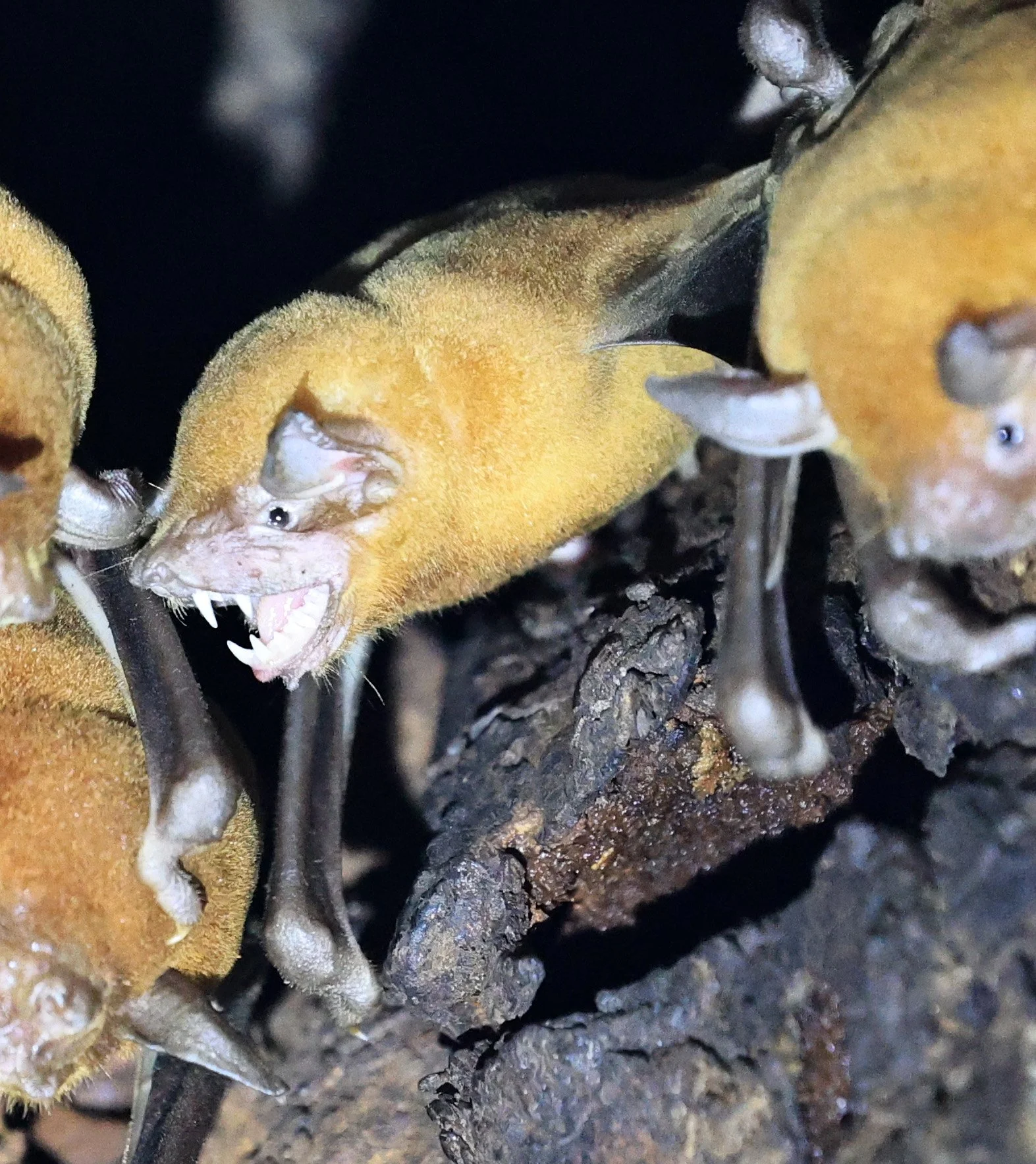
Lesser Bulldog Bat (Noctilio albiventris)
Lesser Bulldog Bat (Noctilio albiventris)
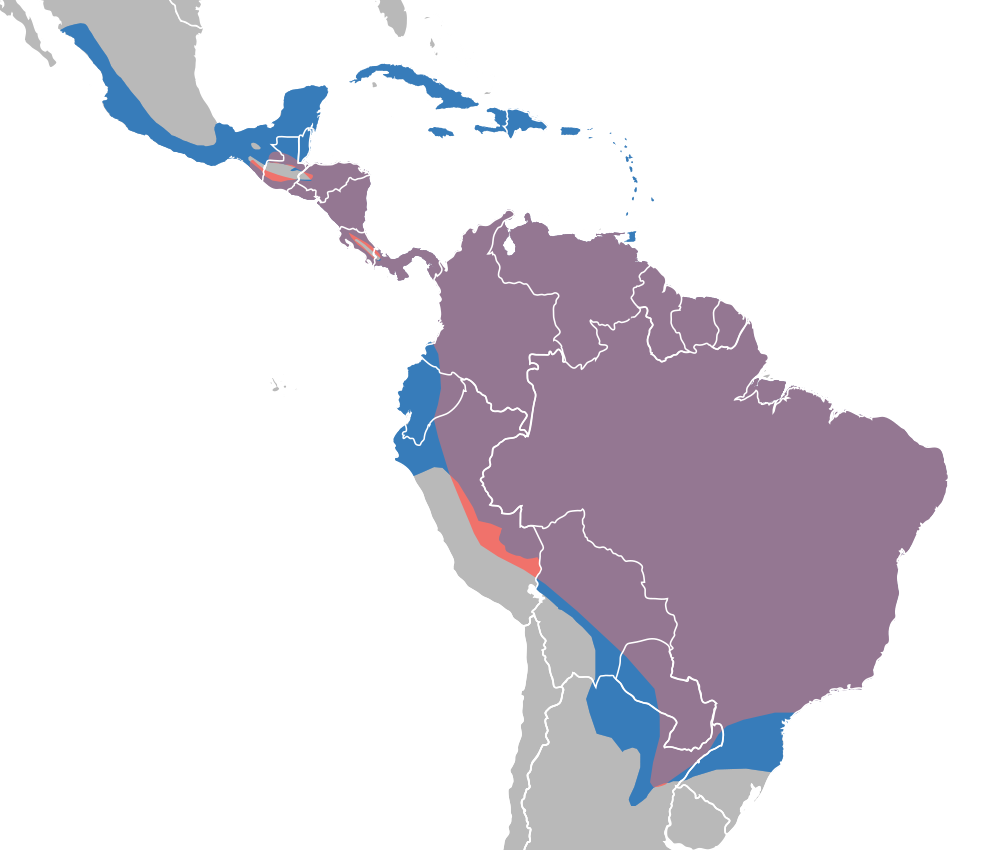
Distribution rangemap of Noctilionidae species. Noctilio albiventris in red, Noctilio leporinus in blue, overlap in purple
Classification
The Lesser Bulldog Bat (Noctilio albiventris) is a distinctive Neotropical bat belonging to the family Noctilionidae, commonly known as the bulldog bats. Its scientific classification is: Kingdom Animalia, Phylum Chordata, Class Mammalia, Order Chiroptera, Family Noctilionidae, Genus Noctilio, and Species N. albiventris. It is one of only two living species in the genus Noctilio, alongside the larger Greater Bulldog Bat (Noctilio leporinus). The species was first described by Anselme Desmarest in 1818. [itis.gov], [mammaldiversity.org]
Bulldog bats are named for their broad muzzles and strong jaws, which give them a somewhat bulldog-like appearance. The Lesser Bulldog Bat is smaller than its better-known relative but shares many adaptations for hunting over water and in open habitats. [animaldiversity.org], [speciesexplorer.org]
General Description
The Lesser Bulldog Bat is a medium-sized bat with a body length of approximately 57 to 85 millimetres and a weight of 18 to 44 grams. It has long, narrow wings adapted for fast, efficient flight over open areas and water surfaces. The fur varies from brown and grey-brown to bright reddish-orange. A striking feature of the species is its sexual dimorphism in colouration, with males often displaying brighter reddish fur while females are generally duller brown. The underparts are noticeably paler than the back, giving rise to the species name albiventris, meaning "white-bellied." [animaldiversity.org]
The species has a pointed muzzle, large ears, and relatively large feet used to capture prey near the water's surface. Unlike many bats, it lacks a prominent nose leaf. The tail extends through a well-developed tail membrane, which assists in flight and prey capture. Although primarily insectivorous, larger individuals occasionally catch small fish or other aquatic prey, showcasing the specialised feeding abilities of the genus. [animaldiversity.org], [speciesexplorer.org]
The Lesser Bulldog Bat relies heavily on echolocation to locate prey and navigate in darkness. It typically hunts over rivers, lakes, ponds, and other water bodies, where concentrations of insects are often high. By consuming large numbers of insects each night, it plays an important ecological role in controlling insect populations. [speciesexplorer.org], [animaldiversity.org]
Distribution
The Lesser Bulldog Bat occurs throughout much of the Neotropics, with a range extending from southern Mexico through Central America and into much of South America, including Brazil, Peru, Bolivia, Paraguay, Venezuela, Colombia, and northern Argentina. It is one of the most widespread species of bulldog bat in the Americas. [animaldiversity.org], [mammaldiversity.org]
Although it inhabits a variety of tropical and subtropical environments, the species is almost always associated with water. It can be found in forests, wetlands, grasslands, riparian habitats, and even some urban areas, provided suitable water sources are nearby. During the day, it roosts in hollow trees, dense foliage, caves, and human-made structures such as buildings and bridges. Colonies may consist of numerous individuals sharing the same roosting site. [animaldiversity.org]

Interesting Facts
The Lesser Bulldog Bat is often considered a specialised aerial insect hunter. Its large feet can be used to rake across the surface of water, allowing it to capture insects and occasionally small aquatic animals. This behaviour is thought to represent an evolutionary precursor to the highly specialised fish-catching techniques used by the larger Greater Bulldog Bat. [speciesexplorer.org], [animaldiversity.org]
The species exhibits a highly synchronized breeding cycle across much of its range. Mating generally occurs in late autumn, with females giving birth to a single pup in the spring. Young bats grow rapidly and are usually capable of flight within about six weeks of birth. Females typically raise only one offspring per year. [animaldiversity.org]
Another interesting characteristic is the strong musky odour produced by colonies. Researchers have noted that roosts occupied by Lesser Bulldog Bats can often be identified by their distinctive scent. The social structure and communication of the species remain active areas of research. [animaldiversity.org]
Conservation Status and Threats
The International Union for Conservation of Nature (IUCN) classifies the Lesser Bulldog Bat as Least Concern due to its extensive distribution, large overall population, and occurrence across a wide range of habitats. The species is found in numerous protected areas throughout Central and South America and currently shows no evidence of significant global population declines. [speciesexplorer.org], [native-nature.org]
Nevertheless, local populations can be affected by habitat destruction, wetland degradation, deforestation, and disturbance of roosting sites. Removal of hollow trees and conversion of natural habitats to agriculture or urban development may reduce suitable roosting and foraging locations. Water pollution could also affect prey availability in some regions. [speciesexplorer.org], [animaldiversity.org]
Despite these pressures, the Lesser Bulldog Bat remains a widespread and adaptable species. Its ability to use a variety of roosting sites and habitats has helped it remain secure across much of its range. Continued conservation of wetlands, rivers, forests, and natural roosting locations will help maintain healthy populations of this unique and ecologically valuable bat. [speciesexplorer.org], [animaldiversity.org]
The below images are from the expedition to Paraguay in 2026:

Lesser Bulldog Bat (Noctilio albiventris) or (Noctilio leporinus) Chaco Lodge & Laguna Salada Paraguay