
Azara’s Night Monkey (Aotus azarae)
Azara’s Night Monkey (Aotus azarae)
Azara’s Night Monkey (Aotus azarae), also known as the Southern Night Monkey, Azara’s Owl Monkey, or mirikiná, is a small primate native to South America. It belongs to the kingdom Animalia, phylum Chordata, class Mammalia, order Primates, and family Aotidae, which contains the night monkeys. The species is classified within the genus Aotus, the only group of monkeys that is primarily active at night. Azara’s Night Monkey was named after the Spanish naturalist Félix de Azara, who made important contributions to the study of South American wildlife. [en.wikipedia.org], [animaldiversity.org], [fws.gov]
Azara’s Night Monkey is one of the smaller New World monkeys, typically weighing about 1 kilogram and measuring between 24 and 37 centimetres in body length, with a tail of similar length. The species has soft grey-brown fur, a rounded head, and very large eyes that are specially adapted for seeing in low-light conditions. Distinctive facial markings include white patches above the eyes and dark stripes running down the face and forehead. Unlike many other monkeys, its tail is not prehensile and cannot be used for grasping branches. Males and females are very similar in appearance, showing little sexual dimorphism. These physical features make the species well suited to its nocturnal lifestyle in forest environments. [animaldiversity.org], [animalia.bio], [en.wikipedia.org]
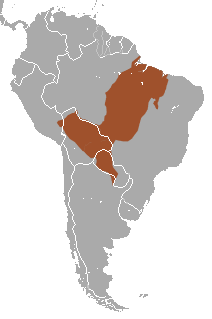
The species is widely distributed across central South America and can be found in Argentina, Bolivia, Paraguay, Brazil, and parts of Peru. It is particularly associated with the Gran Chaco region, as well as gallery forests, semi-deciduous forests, lowland forests, and other wooded habitats. Azara’s Night Monkeys are highly adaptable and can survive in both primary and secondary forests, including areas that have experienced some degree of human disturbance. They spend most of their lives in the trees, where they sleep during the day and move through the canopy while feeding and socializing. [en.wikipedia.org], [animaldiversity.org], [neprimatec...rvancy.org], [animalia.bio]
One of the most interesting features of Azara’s Night Monkey is its unusual activity pattern. While most species of night monkey are strictly nocturnal, some populations of Azara’s Night Monkey are cathemeral, meaning they may be active both during the day and at night. Researchers believe that factors such as moonlight, temperature, and food availability may influence these activity patterns. The species lives in small family groups, usually consisting of an adult breeding pair and their offspring. Unlike many primates, it is largely monogamous, and males play a major role in parental care. Fathers often carry and protect the young, returning them to the mother mainly for nursing. This high level of paternal care is relatively rare among primates. [en.wikipedia.org], [animalia.bio]

Azara’s Night Monkey is primarily a fruit eater, feeding on a wide variety of fruits throughout the year. However, its diet also includes leaves, flowers, insects, spiders, and other small invertebrates. The species uses its excellent night vision and familiarity with forest pathways to forage efficiently in low-light conditions. Family groups communicate through a variety of vocalizations and scent marking, helping them maintain territories and strengthen social bonds. [en.wikipedia.org], [animaldiversity.org]
The International Union for Conservation of Nature (IUCN) currently classifies Azara’s Night Monkey as Least Concern because of its wide distribution, relatively large population, and ability to adapt to different habitat types. Although the species is not currently considered threatened with extinction, local populations may experience pressures from habitat loss and forest fragmentation. [en.wikipedia.org], [animalia.bio]
The main threats facing Azara’s Night Monkey include deforestation, agricultural expansion, and the conversion of natural forests into farmland or grazing areas. These activities can reduce habitat availability and isolate populations from one another. In some regions, monkeys may also be affected by hunting or capture for the pet trade, although these threats are generally less significant than habitat loss. Protecting forest habitats throughout the Gran Chaco and surrounding regions is important for ensuring the continued survival of this species and many other animals that depend on these ecosystems. [neprimatec...rvancy.org], [animaldiversity.org]
Azara’s Night Monkey is a fascinating example of adaptation to life in the forest canopy after dark. Its large eyes, strong family bonds, shared parental care, and flexible activity patterns make it one of the most unusual primates in South America. As an important disperser of seeds and consumer of fruits and insects, it contributes to the health and functioning of forest ecosystems throughout its range. Continued conservation of South American forests will help ensure that this remarkable monkey remains a part of the region’s biodiversity for generations to come. [en.wikipedia.org], [animalia.bio]
Images in the below gallery were taken during the Expedition to the Chaco of Paraguay in 2026:

Azara's Night Monkey (Aotus azarae) Hotel Campestre Iparoma Paraguay


