Humboldt's Hog-nosed Skunk (Conepatus humboldtii), also known as the Patagonian Hog-nosed Skunk, is a member of the family Mephitidae, which contains all skunks. It belongs to the genus Conepatus, a group of skunks distinguished by their elongated, pig-like snouts and strong digging adaptations. Its scientific classification is: Kingdom Animalia, Phylum Chordata, Class Mammalia, Order Carnivora, Family Mephitidae, Genus Conepatus, and Species C. humboldtii. The species was formally described by the British zoologist John Edward Gray in 1837 and named in honour of the famous German naturalist Alexander von Humboldt. [en.wikipedia.org], [grokipedia.com]
General Description
Humboldt's Hog-nosed Skunk is a relatively small and stocky skunk species. Adults typically weigh between 1.5 and 3.0 kilograms and have a body length of approximately 30 to 34 centimetres, with an additional tail length of 17 to 21 centimetres. The fur is generally brownish-black to reddish-brown and marked with prominent white stripes that extend along the back toward the tail. Like other hog-nosed skunks, it has a broad, bare snout that is highly adapted for rooting through soil in search of food. Strong forelimbs and long claws make it an excellent digger. [en.wikipedia.org], [wikiwand.com]
The species is primarily insectivorous but is considered omnivorous. It feeds largely on beetles, grasshoppers, crickets, and other invertebrates, while also consuming rodents, carrion, fruit, and other plant material when available. Its molars are specially adapted for crushing hard-bodied insects and other resistant food items. Like all skunks, Humboldt's Hog-nosed Skunk possesses powerful scent glands that can release a strong-smelling defensive spray when threatened by predators. [en.wikipedia.org], [wikiwand.com]
Distribution
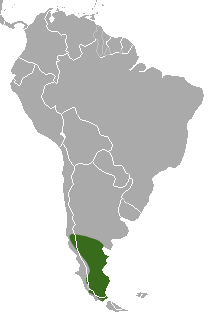
Humboldt's Hog-nosed Skunk is native to the southern regions of South America and is most strongly associated with the Patagonian landscapes of Argentina and Chile. It inhabits open grasslands, steppes, shrublands, and other sparsely vegetated habitats where it can forage efficiently for insects. Although it is most commonly found in open country, it may move into shrublands, forests, and mountainous areas during winter when food becomes less abundant in its preferred habitats. [en.wikipedia.org], [wikiwand.com]
The species is generally found in areas with relatively low human population density and is well adapted to the cool, windy conditions typical of Patagonia. During the day it shelters in burrows or natural dens, emerging mainly at dawn, dusk, or during the night to search for food. Its distribution overlaps with several larger South American carnivores, including foxes, wild cats, and pumas. [en.wikipedia.org], [grokipedia.com]
Interesting Facts
One of the most interesting features of Humboldt's Hog-nosed Skunk is its highly specialised snout, which functions almost like a small shovel. By using its sensitive nose and powerful claws, the skunk can quickly locate and excavate insects hidden beneath the soil. This adaptation allows it to exploit food resources that many other mammals cannot easily access. [en.wikipedia.org], [wikiwand.com] Unlike many carnivores that actively hunt prey, Humboldt's Hog-nosed Skunk often targets prey that is easy to capture, particularly insects. Its diet remains dominated by invertebrates even when competition from other predators increases. The species is generally solitary and spends much of its life alone except during the breeding season. Despite its small size, it is protected by its famous chemical defence, which discourages most predators from attacking. [en.wikipedia.org], [wikiwand.com]
Scientists continue to debate whether Humboldt's Hog-nosed Skunk and Molina's Hog-nosed Skunk (Conepatus chinga) should be treated as separate species because the two are very similar in appearance and show considerable variation in colour patterns across their ranges. [en.wikipedia.org], [wikiwand.com]
Conservation Status and Threats
The International Union for Conservation of Nature (IUCN) currently classifies Humboldt's Hog-nosed Skunk as Least Concern, indicating that the species is not considered at immediate risk of extinction. It also appears in CITES Appendix II, which regulates international trade to ensure that wild populations are not adversely affected. The skunk's broad distribution across Patagonia and its ability to utilise a variety of habitats contribute to its relatively secure conservation status. [en.wikipedia.org], [grokipedia.com]
Although populations are considered stable overall, the species faces several local threats. Habitat modification resulting from agriculture, livestock grazing, road construction, and other human activities can reduce the quality of available habitat. Natural predation from larger carnivores such as pumas, culpeo foxes, pampas cats, and Geoffroy's cats also affects local populations. Continued monitoring and habitat conservation are important for ensuring that Humboldt's Hog-nosed Skunk remains a characteristic species of the Patagonian ecosystems of Argentina and Chile. [en.wikipedia.org], [laboratorynotes.com]